
History of the Brown-Austin House
“There is no place in Kensington sixty years ago that seemed to have so much of the quiet atmosphere and beauty of the older days as this house”- Roland D. Sawyer

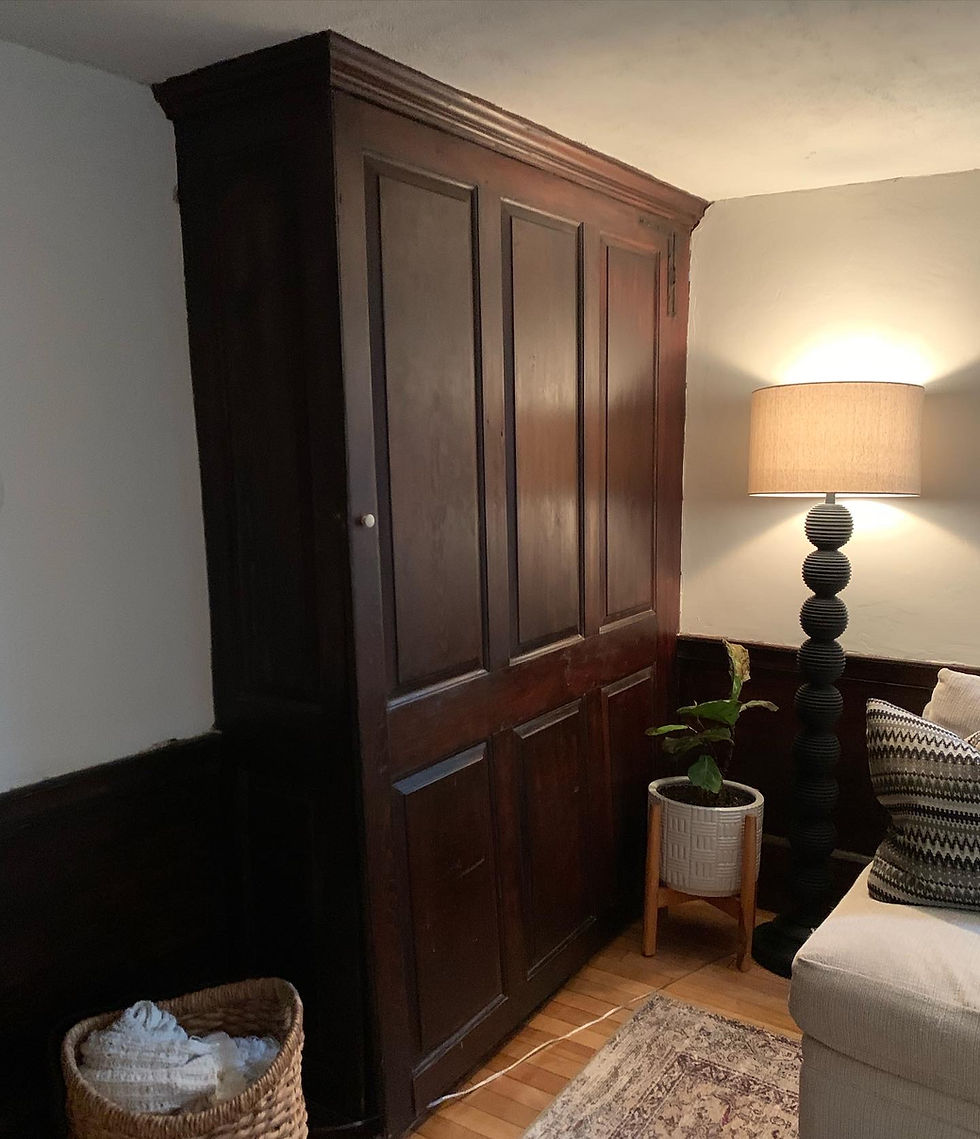
The original portion of the house, which is no longer standing, was built in 1737 by Benjamin Brown. Benjamin Brown was married to Elizabeth Batchelder in 1738, and as soon as their new home was completed, they had 13 children! The original house and the current house were both built in the Georgian-style with a 3-room configuration around the central chimney. The section that stands now was built later by one of Benjamin Brown’s sons, Stephen. Local 18th century architecture expert, Steven Mallory, walked through the house in October 2022 and determined that the remaining section of the house was constructed c. 1760 based on the lack of summer beams on the first floor, a building practice which was largely abandoned in this area of New England starting around 1750. One notable architectural feature is an original pantry cupboard in the living room (photo below). The house sheltered two or three families at a time when the Brown’s occupied it in the 18th and early 19th centuries. A photo taken by Roland Sawyer in 1899 (below) shows original portion of the house that was torn down.

In 1855, Deacon Samuel Austin from Salisbury moved in to one half of the house and carried on the farm, as the Brown widow and her two daughters were unable to take on the farm by themselves. Samuel’s two sons, Joseph Newton (known as Newt) and James, both fought in the Civil War before returning to Kensington. Each married one of the Brown sisters and lived in half of the house. Originally the site was known as “Brown’s corner,” but later became known as “Austin’s Corner.” Deacon Austin was one of several Kensington residents who donated $50.00 in 1865 for the building of the Congregational Church building. He preached for the Congregational Church and served as superintendent for its Sunday School. Deacon Austin's son, 'Newt', served as Kensington’s moderator, a selectman, and as Kensington’s democratic state representative in 1889. He was also notable as the head a committee for the setting off fireworks at the Great Democratic Celebration of 1884 to celebrate the election of Grover Cleveland to the presidency.

In 1939, new owners from New York City, Mr. and Mrs. Eugene Simon, moved in and renovated the home, taking down the original 1737 section of the house (shown in the 1899 photo above). The Simons removed some of its paneling to install in the existing section of the house. The two halves of the house were reportedly connected by a central hall and this configuration was changed during the Simon's tenure here. The early 20th century renovations are clear upon inspection of the house. The main fireplace in the kitchen has early 20th century brick and several different species of wood paneling surrounding it, which indicates that at least some of the paneling was reused from elsewhere.
Eugene Simon was listed as a retired fireman in the 1940 census of Rockingham County. Records reveal that he entered into civil service in 1918 for Engine Company No. 33 at 42-44 Great Jones St., Manhattan (shown below) and lived in Long Island City. His 23-year-old son, William, was listed as a laborer in the carpentry trade. Alice Simon, who was born in Massachusetts, was not employed but recorded as keeping the home. The house was listed at a value of $2500 in 1940. In 1938, the valuation of the house on tax records is $1400, so the improvements made by the Simons were clearly substantial.
The 10-footer shoe shop (shown below) that remains on the property was built in 1858 by Jim Eaton, a carpenter from South Hampton, for Calvin Sawyer, and moved to this site in 1870. In 1880, Kensington had 22 of these small shoe shops, as well as shoemakers who worked from smaller sheds or from within their home. In 1885, Kensington had 74 farmers and 74 shoemakers. One of the first Kensington shoe entrepreneurs was John T. Blake, who went to Boston to learn the trade of boot-making. In 1829, he returned home to open up shop on Amesbury Road. At the height of business, he employed 40 local men and women in the making of boots and shoes. The average pay for a shoemaker was $125/year in the 1880s. According to Roland Sawyer, in the 1880s much of the shoe work in town was brought from Haverhill by Newt Austin, who lived here in this house. At that time, he had over 30 workers under his employment.

After the Simon family sold the property, the Healsley family owned it until 2022, but the house was lived in by Carole Warren. And now its proud new owners, the Houston family, carry on the tradition of maintaining a piece of Kensington history!
This history was compiled from House files at Kensington Public Library, Sawyer’s History of Kensington, online census records and online burial records by Meghan Gross, President, Kensington Historical Society, October 2022


Comments